



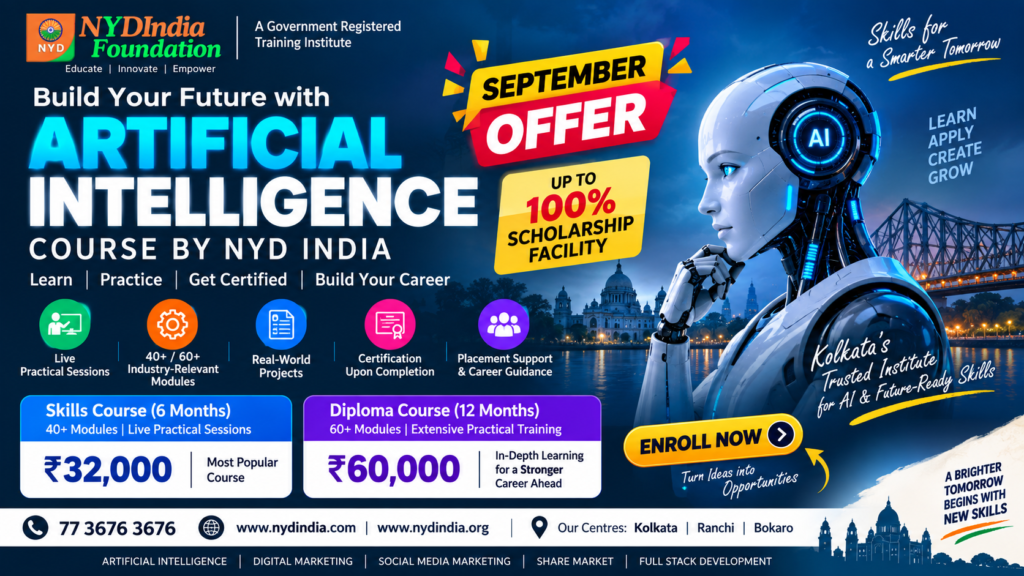
Building a Future-Ready Career: A Look at the Artificial Intelligence Course by NYD India

Artificial Intelligence has moved well beyond the realm of research labs and science fiction. It now shapes how hospitals diagnose patients, how banks detect fraud, how retailers personalize recommendations, and how businesses automate everyday operations. For students, job seekers, entrepreneurs, and working professionals alike, this shift has opened up one of the fastest-growing career paths in the world. For anyone looking to build practical, job-ready AI skills, the Artificial Intelligence Course offered by NYD India is worth a closer look.
Who Is NYD India?
NYD India is a training institute that has positioned itself around skill-based, career-oriented education. Rather than focusing purely on theory, the institute has built its reputation on hands-on learning models designed to prepare students for real workplace demands — spanning fields like digital marketing and, increasingly, artificial intelligence.
What the AI Course Covers
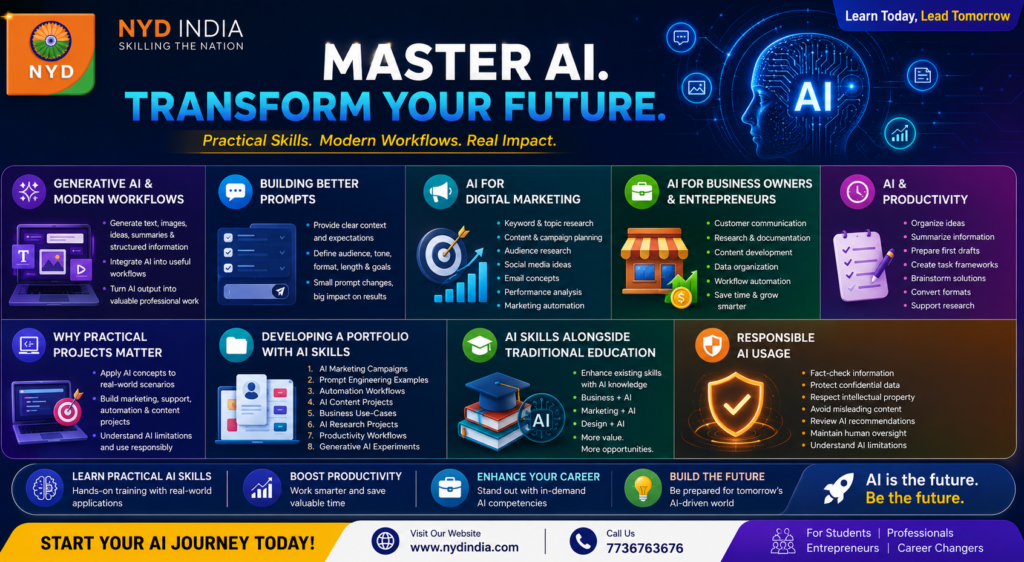
NYD India’s Advanced Artificial Intelligence Course is built for a wide range of learners — from complete beginners to professionals looking to upskill. The curriculum is designed to walk students through core AI concepts, essential tools, automation techniques, and machine learning fundamentals, with an emphasis on how these technologies are applied in real business settings.
A few standout elements of the course include:
- Live, practical training — Rather than relying solely on lectures and textbooks, students work directly with AI tools and technologies through demonstrations and projects.
- Real-world application focus — The course is structured around how AI is actually used across industries today, not just abstract theory.
- Hands-on projects — Learners get to apply concepts as they go, building the kind of practical experience employers look for.
- Certification on completion — Graduates receive a certificate that can add credibility to their professional profile.
- Career and placement support — The institute offers guidance aimed at helping students transition from the classroom into the job market.
Why Practical, Hands-On Learning Matters
One of the more common criticisms of technical education is that it can be too theoretical, leaving students with knowledge but not necessarily confidence or capability. AI, in particular, is a field where hands-on exposure makes an enormous difference — understanding how a machine learning model works conceptually is very different from actually building, training, and troubleshooting one.
By centering the course around live projects and practical implementation, NYD India’s approach aims to close that gap, helping learners walk away with tangible experience they can point to in interviews and on the job.
Who Should Consider This Course
The course is designed to be accessible to a broad audience:
- Students looking to specialize early and enter the AI job market with a competitive edge.
- Job seekers aiming to pivot into a high-demand technology field.
- Entrepreneurs who want to understand how AI can be applied to their own businesses.
- Working professionals seeking to add AI skills to their existing expertise and stay relevant as their industries evolve.
The Bigger Picture: Why AI Skills Are in Demand
Across sectors — healthcare, finance, marketing, logistics, and beyond — organizations are increasingly looking for people who understand how to work with AI tools and integrate automation into everyday processes. This demand isn’t limited to engineers and data scientists; marketers, analysts, and operations professionals are all expected to have at least a working familiarity with AI-driven tools.
That broader shift is part of what makes structured, practical AI training valuable right now. Skills gained through a course like this one don’t just apply to a narrow set of “AI jobs” — they’re increasingly relevant across almost every modern career path.
Final Thoughts
If you’re looking to build a future-ready career and want an AI course that prioritizes hands-on learning over theory alone, NYD India’s Artificial Intelligence Course is a program worth researching further. As with any training program, it’s worth reaching out directly to the institute to confirm current curriculum details, fees, schedules, and placement outcomes before enrolling — but the overall approach of practical, project-based AI education reflects exactly what today’s job market is asking for.
Interested in learning more? Visit NYD India’s official website for the most up-to-date course details, fee structure, and enrollment information.
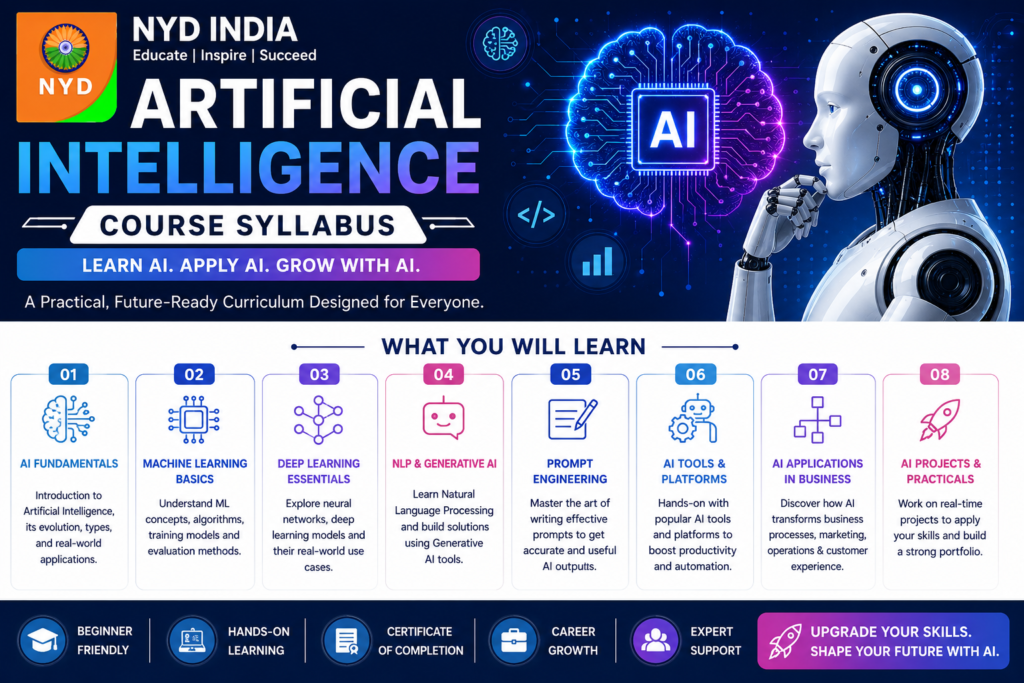
Complete Artificial Intelligence Course
Comprehensive Syllabus — 50+ Modules
A full-stack curriculum taking a learner from mathematical foundations to advanced generative AI, MLOps, and specialized applications.
PART 1: FOUNDATIONS (Modules 1–10)
Module 1 — Introduction to AI History of AI, types of AI (narrow, general, super), real-world applications, AI vs ML vs DL vs Data Science.
Module 2 — Python for AI Syntax, data structures, functions, OOP, file handling, virtual environments.
Module 3 — NumPy & Array Computing Arrays, broadcasting, vectorization, linear algebra operations.
Module 4 — Pandas for Data Handling DataFrames, cleaning, merging, grouping, time-series basics.
Module 5 — Data Visualization Matplotlib, Seaborn, Plotly; exploratory data analysis (EDA).
Module 6 — Linear Algebra for AI Vectors, matrices, eigenvalues/eigenvectors, matrix decomposition.
Module 7 — Calculus for Machine Learning Derivatives, partial derivatives, gradients, chain rule.
Module 8 — Probability & Statistics Distributions, Bayes’ theorem, hypothesis testing, statistical inference.
Module 9 — Optimization Basics Gradient descent, convex vs non-convex optimization, learning rate.
Module 10 — Data Preprocessing & Feature Engineering Handling missing data, encoding, scaling, feature selection/extraction.
PART 2: MACHINE LEARNING (Modules 11–22)
Module 11 — Introduction to Machine Learning Supervised, unsupervised, semi-supervised, reinforcement learning overview.
Module 12 — Regression Algorithms Linear, polynomial, ridge, lasso regression.
Module 13 — Classification Algorithms Logistic regression, k-NN, Naive Bayes.
Module 14 — Decision Trees & Ensemble Methods Decision trees, Random Forest, Bagging.
Module 15 — Boosting Algorithms Gradient Boosting, XGBoost, LightGBM, CatBoost.
Module 16 — Support Vector Machines Kernel trick, margin maximization, SVM for classification/regression.
Module 17 — Clustering Algorithms K-Means, Hierarchical clustering, DBSCAN.
Module 18 — Dimensionality Reduction PCA, t-SNE, UMAP, LDA.
Module 19 — Model Evaluation & Validation Cross-validation, confusion matrix, ROC-AUC, precision/recall/F1.
Module 20 — Hyperparameter Tuning Grid search, random search, Bayesian optimization, Optuna.
Module 21 — Handling Imbalanced Data SMOTE, undersampling/oversampling, class weighting.
Module 22 — ML Pipelines & Scikit-learn Mastery Pipelines, ColumnTransformer, custom estimators.
PART 3: DEEP LEARNING (Modules 23–32)
Module 23 — Neural Network Fundamentals Perceptron, activation functions, forward/backward propagation.
Module 24 — Deep Learning Frameworks TensorFlow/Keras and PyTorch basics.
Module 25 — Training Deep Networks Loss functions, optimizers (SGD, Adam, RMSProp), batch normalization.
Module 26 — Regularization Techniques Dropout, L1/L2 regularization, early stopping, data augmentation.
Module 27 — Convolutional Neural Networks (CNNs) Convolution, pooling, architectures (LeNet, VGG, ResNet, EfficientNet).
Module 28 — Computer Vision Applications Image classification, object detection (YOLO, Faster R-CNN), segmentation.
Module 29 — Recurrent Neural Networks (RNNs) RNN, LSTM, GRU, sequence modeling.
Module 30 — Attention Mechanisms Self-attention, multi-head attention, encoder-decoder attention.
Module 31 — Transformers Architecture “Attention Is All You Need,” positional encoding, transformer blocks.
Module 32 — Transfer Learning Pretrained models, fine-tuning, feature extraction vs full fine-tuning.
PART 4: NATURAL LANGUAGE PROCESSING (Modules 33–39)
Module 33 — NLP Fundamentals Tokenization, stemming, lemmatization, stopwords, POS tagging.
Module 34 — Text Representation Bag-of-Words, TF-IDF, Word2Vec, GloVe, FastText.
Module 35 — Sequence Models for NLP Text classification with RNN/LSTM, sentiment analysis.
Module 36 — BERT & Transformer-Based NLP BERT, RoBERTa, DistilBERT, fine-tuning for downstream tasks.
Module 37 — Large Language Models (LLMs) GPT family, LLaMA, architecture, training at scale, tokenization (BPE).
Module 38 — Prompt Engineering Zero-shot, few-shot, chain-of-thought, prompt design patterns.
Module 39 — Retrieval-Augmented Generation (RAG) Vector databases, embeddings, semantic search, RAG pipelines.
PART 5: GENERATIVE AI (Modules 40–45)
Module 40 — Introduction to Generative AI Discriminative vs generative models, applications landscape.
Module 41 — Autoencoders & Variational Autoencoders Encoder-decoder structure, latent space, VAE loss.
Module 42 — Generative Adversarial Networks (GANs) Generator/discriminator, DCGAN, StyleGAN, training challenges.
Module 43 — Diffusion Models Denoising diffusion, Stable Diffusion, image generation pipelines.
Module 44 — AI Agents Agentic architectures, tool use, planning, multi-agent systems.
Module 45 — Fine-Tuning & Alignment LoRA, QLoRA, RLHF, instruction tuning, PEFT methods.
PART 6: REINFORCEMENT LEARNING (Modules 46–49)
Module 46 — RL Fundamentals Markov Decision Processes, reward, policy, value functions.
Module 47 — Value-Based Methods Q-Learning, Deep Q-Networks (DQN).
Module 48 — Policy-Based & Actor-Critic Methods REINFORCE, A2C/A3C, PPO.
Module 49 — RL Applications Game AI, robotics, RLHF for LLM alignment.
PART 7: MLOps, ETHICS & DEPLOYMENT (Modules 50–56)
Module 50 — Model Deployment REST APIs (Flask/FastAPI), Docker, cloud deployment (AWS/GCP/Azure).
Module 51 — MLOps Pipelines CI/CD for ML, MLflow, model versioning, monitoring.
Module 52 — Scalable AI Systems Distributed training, model serving at scale, quantization, ONNX.
Module 53 — AI Ethics & Responsible AI Bias, fairness, explainability (SHAP, LIME), transparency.
Module 54 — AI Safety & Governance Alignment, robustness, regulation landscape (EU AI Act, etc.).
Module 55 — AI Security Adversarial attacks, prompt injection, model theft, data poisoning.
Module 56 — Capstone Project End-to-end project: problem framing → data → model → deployment → presentation.
BONUS: SPECIALIZATION TRACKS (Modules 57–60)
Module 57 — AI for Robotics Perception, SLAM, control with RL.
Module 58 — AI in Healthcare Medical imaging, diagnosis models, regulatory considerations.
Module 59 — AI in Finance Fraud detection, algorithmic trading, credit risk modeling.
Module 60 — Multimodal AI Vision-language models (CLIP, GPT-4V-style), audio-visual learning.
Suggested Duration
- Fast track: 4–5 months (full-time, 6 hrs/day)
- Standard track: 8–10 months (part-time, 2 hrs/day)
- Prerequisites: Basic programming knowledge helps but Modules 1–10 cover it from scratch.
Recommended Tools Throughout
Python, Jupyter/Colab, NumPy, Pandas, Scikit-learn, TensorFlow/Keras, PyTorch, Hugging Face Transformers, LangChain, Docker, Git/GitHub, MLflow, cloud platform of choice (AWS/GCP/Azure).
What NYD India Is
NYD India (also known as “National Youth Development of India”) is a privately owned training and education company founded in 2019, based in Kolkata, that positions itself as a top-level institute for digital marketing and share market training with placement services. It’s a small organization, reportedly employing between 11 and 50 people.
The organization also describes itself as a government-registered institute offering various skill development courses along with quality services, including scholarships based on students’ financial condition and placement facilities during the course. It runs a companion nonprofit-style arm, NYD India, which frames itself as an “Organisation for Youth Development” focused on raising awareness and helping young people build a better future.
Courses Offered
The core course catalog centers on:
- Digital Marketing (including an AI-enhanced/advanced track)
- Share Market Training (with live trading support alongside the classroom instruction)
- AI-related skills training
- Social Media Marketing as a distinct certification track (student Bikram Dutta is noted as having received a Social Media Marketing skill development course certification from NYD India)
NYD India presents itself as a Skilled Development Training Institute aimed at equipping youth with practical, industry-relevant skills, with courses designed to build both technical knowledge and career readiness.
Members / Team
Information on formal “members” is limited to student testimonials and faculty descriptions rather than a public roster of staff or leadership. Key points from reviews and the company’s own site:
- Teaching faculty are described as having more than five years of experience in the teaching field.
- The organization describes its team members as highly experienced in their respective fields.
- The organization emphasizes personalized, one-on-one instruction, with individual attention given to each student rather than large group classes.
- Recent reviews (2025–2026) describe the institute as active in multiple cities, including Kolkata and Ranchi, offering AI-based digital marketing training with supportive faculty.